
Travelling a Horse Long Distance: A Practical Guide
Quick Summary
"Long journeys tax a horse more than most owners realise — through balance, dehydration and standing fatigue. Here is how to plan the trip, and where graduated compression fits into arriving sound and settled."
A horse arrives at its destination tired for reasons that have little to do with the miles. Standing in a moving box asks the legs to brace continuously against acceleration, braking and camber, while restricted movement slows the circulation that normally clears fluid from the lower limbs. Plan a long journey around three things — steady legwork on the horse's part, hydration, and recovery either side of the trip — and most animals travel and unload well. This guide covers how to prepare, what to manage on the road, and where a Hidez travel and recovery suit earns its place.
Why is long-distance travel so tiring for a horse?
Travel fatigue comes from constant micro-adjustment, not distance alone. To stay upright in a moving vehicle a horse braces and rebalances with almost every second, so the postural muscles never fully rest — the equine equivalent of standing on a train for hours. At the same time, limited walking reduces the pumping action of the hoof and lower leg that drives venous blood and lymph back up towards the heart, which is why lower limbs can "fill" and feel puffy after a long haul. Add the drying air of a ventilated box and many horses step off mildly dehydrated and stiff. None of this is dangerous in a healthy horse, but it is why arrival condition varies so much between a well-planned trip and a rushed one.
How do you prepare a horse for a long journey?
Preparation starts days before, not on the ramp. Make sure your horse is well hydrated in the 48 hours beforehand, and consider soaking hay or feeding a wet mash to carry extra water into the trip. Load a familiar haynet so the horse has something to do, and check that your vehicle's ventilation is working and the floor is clean and non-slip. Take exact measurements before ordering any travel gear — graduated compression only does its job when the fit is correct — using the Hidez sizing guide. Fit the suit calmly in the yard a few times before travel day so the sensation is old news by the time it matters. A horse meeting new pressure for the first time in a moving box has two novelties to cope with instead of one.
Should a horse wear a compression suit during transport?
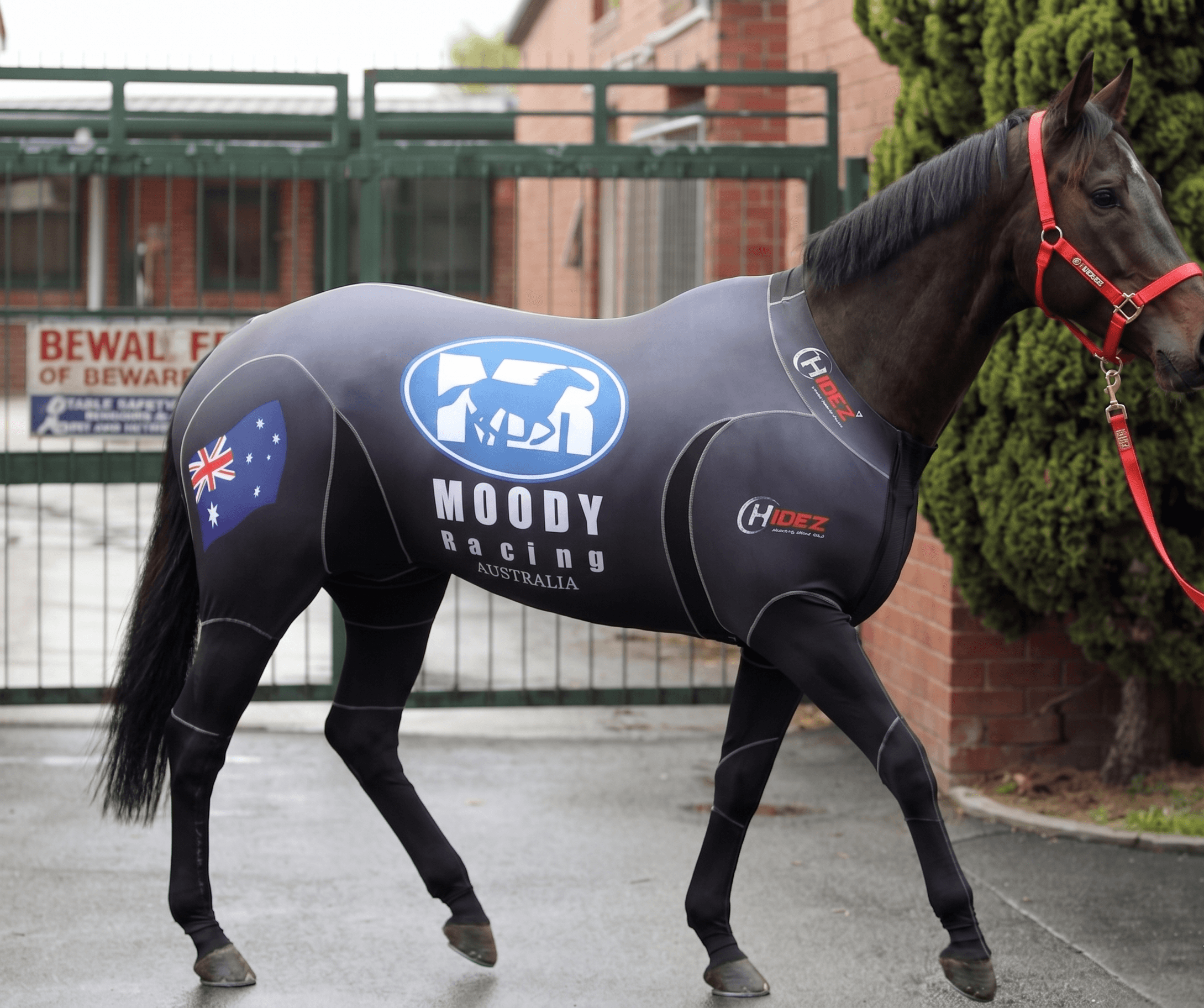
Yes — transport is one of the clearest uses for a full-body compression suit, for two reasons at once. The Hidez travel and recovery suit applies patented graduated compression that supports circulation while the horse stands relatively still, helping to counter the limb filling that long stationary periods encourage. Just as importantly, the steady, even pressure of the fabric produces a calming deep-pressure effect — the same swaddle principle that settles an anxious animal — which helps a nervous traveller stand quieter and expend less energy fretting. This is the design Black Caviar's team chose for her 30-hour flight to Royal Ascot in 2012: she travelled in a Hidez suit and stepped off looking fresh. The suit does not replace good driving, frequent checks or veterinary advice; it supports the horse doing hard, quiet work on its own account.
How often should you stop and check the horse?
On a long haul, plan a brief check roughly every three to four hours, and use fuel or rest stops to offer water and look the horse over. You are watching for the ordinary signs that a horse has had enough for now: reluctance to drink, a dull eye, patchy sweating, or persistent pawing and weight-shifting beyond normal fidgeting. Offer water at every stop even if the horse refused earlier — many will drink once the vehicle is still. If you are crossing on a ferry, settle the horse before the crossing and keep the routine calm and predictable; the constant low vibration of a hull is another form of the same standing fatigue, and a horse that is already relaxed copes with it far better. Anything that looks like genuine distress rather than boredom is a reason to stop properly and, if it persists, to call a vet.
What should you do when you arrive?
Recovery is part of the journey, not something separate from it. On arrival, walk the horse in hand to restart circulation in the legs before it goes to stand in a stable, offer water and a small feed, and give it time before asking anything athletic — a horse that has just travelled for a day is not ready to compete or work hard within the hour. Many owners keep a compression garment on for the first stretch of rest, or fit graduated compression socks (our guide to horse compression socks explains the options) to support the lower limbs specifically while the horse settles and any travel-related filling subsides. Check legs and feet, watch how the horse moves the next morning, and let its own behaviour tell you when it is back to itself.
The short version
Travel fatigue is mostly about balance, hydration and standing still, so the fixes are steady preparation, water, regular checks and unhurried recovery at the far end. Graduated compression supports the circulation and calm that a long journey works against — during the trip and in the hours after it. Measure carefully, introduce the suit at home, and let the horse arrive on its own timetable. You can see the full range for equine travel and recovery in the Hidez horse collection.